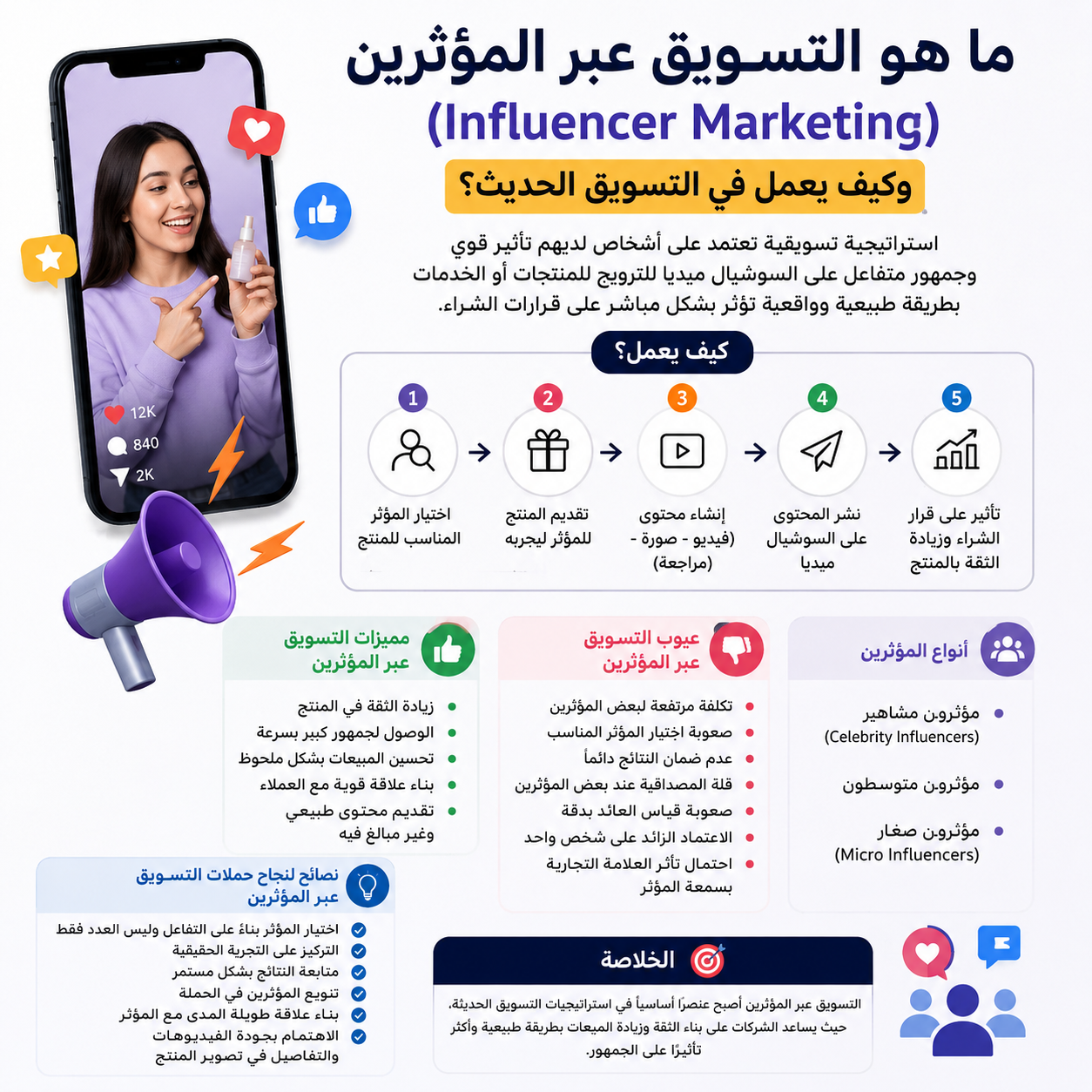
What is influencer marketing, and why do companies rely on it?
In the modern world of digital marketing, traditional advertising alone is no longer sufficient to capture customer attention or earn their trust; consequently, influencer marketing has emerged as one of the most effective and widespread strategies. This approach relies on individuals who possess significant influence and an engaged audience on social media platforms. By sharing their genuine experiences with products and services, they lend greater credibility and persuasiveness to the marketing message directly influencing purchasing decisions.
What is influencer marketing?
Influencer marketing is a strategy that involves collaborating with individuals who have large, active audiences on social media platforms—such as Instagram, TikTok, and YouTube—to promote a specific product or service. Instead of direct advertising by the company, the influencer tries the product and shares it with their followers, making the message feel more natural and authentic You can also consult https://www.hubspot.com/ HubSpot’s guide for a deeper understanding of influencer marketing, or check out Meta Business https://www.facebook.com/business, as both provide comprehensive information on the subject.
How does influencer marketing work?
- Selecting an influencer suitable for the product type
- Sending the product to him to try out
- The influencer creates content (video, image, or review)
- Publishing content for the audience on social media
Examples of Influencer Marketing?
- A beauty influencer tries out a skincare cream and shares his experience.
- A tech YouTuber reviews a new phone.
- A travel blogger shares his experience at a hotel.
- A fashion influencer styles outfits from a brand.
- A food influencer tries out a new restaurant and reviews it.
- A TikToker showcases a cleaning product, showing the "before" and "after" results.
- Mom influencer showcasing products for children
- An influencer using products in their daily routine.
- Sports influencer shares his experience with nutritional supplements.
Advantages of Influencer Marketing
- Increasing confidence in the product
- Reaching a large audience quickly
- Significantly improving sales
- Building a strong relationship with customers
- Presenting natural, unexaggerated content.
Drawbacks of Influencer Marketing
- High cost for some influencers
- The difficulty of choosing the right influencer.
- Results are not always guaranteed.
- Lack of credibility among some influencers
- Difficulty in accurately measuring the return
- Over-reliance on a single person
- The likelihood of the brand being affected by the influencer's reputation.
Types of Influencers (Influencer Marketing)
- Celebrity Influencers
- Mid-tier influencers
- Micro-influencers
How to Choose the Right Influencer (Influencer Marketing)
- To be in the same field as the product.
- Genuine interaction with the audience
- Brand-safe content
- Alignment of the audience with the target segment
Tips for Successful Influencer Marketing Campaigns
- Selecting an influencer based on engagement, not just numbers.
- Focusing on the authentic experience
- Continuously monitoring the results
- Diversifying the influencers in the campaign
- Building a long-term relationship with the influencer.
- Focusing on video quality
- And paying attention to the details of product photography.
Secrets You Need to Know About Influencer Marketing
- Follower count isn't what matters most.
A major mistake some brands make is focusing on "follower count." An influencer with a million followers might not deliver results, whereas a micro-influencer with
10,000 followers could generate higher sales.
- Trust is the foundation.
Audiences do not trust direct advertisements, but they do trust the people they follow daily. Therefore, the success of influencer marketing depends on
- Authenticity of the experience
- Natural display style
- Avoid over-promoting
- Choosing the wrong influencer ruins the campaign.
Not every influencer is a good fit for your brand. An influencer might be famous, but their audience may have no interest in your field at all.
- In the same field
- An audience similar to your customers
- A content style aligned with the brand identity.
- Sometimes, content is more important than the product itself.
A successful influencer sells not just the product, but the experience. The filming style, the story, and the approach can make a significant difference in the purchasing decision.
- A long-term relationship is better.
Ongoing collaboration with the same influencer yields stronger results than just a single advertisement.
- Creative freedom is important.
The more freedom an influencer has with their content, the more impactful and authentic the result becomes.
Influencer marketing has become a key component of modern marketing strategies, helping companies
build trust and increase sales in a natural way that has a greater impact on the audience.
https://gravity-media.net/wp-admin/post.php?post=1016&action=edit
Conclusion (Influencer Marketing)
Influencer marketing has become a key component of modern marketing strategies, helping companies build trust and increase sales in a natural way that has a greater impact on the audience.