- Introduction
In today's fast-paced digital world, Digital Marketing has become one of the most essential strategies for businesses looking to grow, attract customers, and stay competitive. Traditional marketing methods alone are no longer enough, as consumers increasingly rely on search engines, social media platforms, websites, and mobile apps to discover products and services.
Digital Marketing encompasses a wide range of online strategies, including Search Engine Optimization (SEO), Content Marketing, Social Media Marketing, Email Marketing, Pay-Per-Click (PPC) Advertising, Affiliate Marketing, and more. These channels enable businesses to reach the right audience, build brand awareness, generate qualified leads, and drive measurable sales while optimizing marketing budgets.
Whether you're a business owner, entrepreneur, digital marketer, content creator, or someone interested in starting a career in marketing, understanding the fundamentals of Digital Marketing is essential in today's digital economy. It provides the knowledge and tools needed to connect with customers effectively and achieve long-term business growth.
In this comprehensive guide, you'll learn what Digital Marketing is, why it matters, its main types and channels, key performance metrics, essential tools, proven strategies, current trends, common mistakes to avoid, and how to get started successfully. By the end of this article, you'll have a solid understanding of Digital Marketing and how to leverage it to achieve your personal or business goals.
- What Is Digital Marketing?
Digital Marketing refers to all marketing activities that use the internet and digital technologies to promote products, services, or brands. Its primary goal is to reach the right audience, build strong customer relationships, increase brand awareness, generate leads, and drive sales through various online channels.
Digital Marketing utilizes a wide range of platforms and tools, including search engines, social media platforms, websites, email, mobile applications, and online advertising. These channels allow businesses to connect with potential customers anytime and anywhere, making marketing more accessible and effective than ever before.
Unlike traditional marketing, Digital Marketing enables businesses to target specific audiences based on factors such as demographics, location, interests, online behavior, and purchasing habits. This precise targeting helps improve campaign performance, optimize marketing budgets, and maximize Return on Investment (ROI). Additionally, digital marketing provides real-time analytics and performance data, allowing marketers to measure results, understand customer behavior, and continuously optimize their strategies.
Today, Digital Marketing has become an essential part of business success for companies of all sizes—from startups and small businesses to large global enterprises. By leveraging the right digital channels and strategies, businesses can expand their online presence, attract more customers, and achieve sustainable growth in an increasingly competitive digital landscape.
- Why Is Digital Marketing Important?
Digital Marketing has become a fundamental part of business success in today's digital-first world. As consumers increasingly rely on search engines, social media platforms, websites, and mobile apps to discover products and services, having a strong online presence is no longer optional—it's essential for reaching customers, building brand awareness, and driving business growth.
Here are the key reasons why Digital Marketing is so important:
1. Reach a Wider Audience
Digital Marketing enables businesses to connect with potential customers across the globe without geographical limitations. Whether you're a local business or an international brand, digital channels provide opportunities to expand your market and increase visibility.
2. Target the Right Audience
One of the biggest advantages of Digital Marketing is precise audience targeting. Businesses can reach users based on demographics, location, interests, online behavior, and purchasing habits, resulting in more effective campaigns and higher conversion rates.
3. Cost-Effective Marketing
Compared to traditional advertising methods such as television, radio, or print media, Digital Marketing offers more affordable solutions. Businesses of all sizes can launch campaigns with flexible budgets while maximizing their return on investment.
4. Measurable Results
Digital Marketing provides real-time analytics and detailed performance reports. Marketers can track website traffic, clicks, conversions, sales, engagement, and other key metrics, making it easier to evaluate campaign success and optimize future strategies.
5. Increase Brand Awareness
Maintaining an active presence across search engines, social media platforms, and other digital channels helps businesses improve brand recognition, build credibility, and stay top-of-mind with their target audience.
6. Boost Sales and Conversions
By delivering personalized content and targeted advertising to the right audience at the right time, businesses can generate qualified leads, increase conversion rates, and drive more sales.
7. Build Strong Customer Relationships
Digital Marketing enables direct communication with customers through social media, email, live chat, and other online channels. This interaction improves customer satisfaction, encourages engagement, and strengthens long-term loyalty.
8. Flexibility and Continuous Optimization
Unlike traditional marketing, digital campaigns can be updated, paused, or optimized at any time based on performance data. This flexibility allows businesses to improve results and adapt quickly to changing market conditions.
9. Stay Competitive
A strong Digital Marketing strategy helps businesses compete effectively in today's competitive marketplace. Even small and medium-sized businesses can compete with larger brands by using smart targeting, quality content, and data-driven marketing strategies.
10. Support Long-Term Business Growth
Digital Marketing helps businesses achieve a wide range of objectives, including increasing sales, generating leads, improving customer retention, expanding market reach, and building a sustainable online presence that supports long-term success.
- Types of Digital Marketing
Digital Marketing consists of a wide range of strategies and channels that help businesses reach their target audience, increase brand awareness, generate leads, and drive sales. Each type of digital marketing serves a unique purpose, and most successful businesses combine multiple strategies to achieve the best results.
Below are the most common types of Digital Marketing:
1. Search Engine Optimization (SEO)
Search Engine Optimization (SEO) is the process of improving a website's visibility in organic (non-paid) search engine results. It involves optimizing website content, keywords, site speed, user experience, and backlinks to attract more qualified traffic and improve search rankings.
2. Search Engine Marketing (SEM)
Search Engine Marketing (SEM) involves promoting websites through paid search advertising, such as Google Ads. Businesses use SEM to appear at the top of search engine results pages, attract targeted visitors, and generate leads or sales quickly.
3. Content Marketing
Content Marketing focuses on creating and distributing valuable, relevant, and engaging content—such as blog posts, articles, videos, infographics, podcasts, and eBooks—to attract, educate, and retain a target audience while encouraging profitable customer actions.
4. Social Media Marketing (SMM)
Social Media Marketing (SMM) uses platforms such as Facebook, Instagram, TikTok, LinkedIn, X (formerly Twitter), and Pinterest to promote products or services, engage with customers, build brand awareness, and drive website traffic and sales.
5. Email Marketing
Email Marketing is one of the most effective digital marketing strategies. It involves sending personalized emails, newsletters, promotional offers, product updates, and automated campaigns to nurture leads, strengthen customer relationships, and increase conversions.
6. Affiliate Marketing
Affiliate Marketing is a performance-based marketing strategy in which affiliates promote a company's products or services in exchange for a commission on every sale, lead, or specific action generated through their referral links.
7. Influencer Marketing
Influencer Marketing involves partnering with social media influencers or content creators to promote products or services to their followers. This strategy helps businesses increase credibility, expand their reach, and build trust with potential customers.
8. Performance Marketing
Performance Marketing is a results-driven approach where advertisers pay only when a specific action is completed, such as a click, lead, conversion, or sale. It focuses on maximizing return on investment (ROI) through measurable campaign performance.
9. User-Generated Content (UGC) Marketing
User-Generated Content (UGC) Marketing leverages content created by customers, such as reviews, testimonials, photos, videos, and social media posts, to build trust, enhance brand authenticity, and influence purchasing decisions.
10. Video Marketing
Video Marketing uses video content to promote products, services, or brands across platforms like YouTube, TikTok, Instagram Reels, Facebook, and YouTube Shorts. It is one of the most engaging forms of digital content and plays a key role in increasing audience engagement.
11. Mobile Marketing
Mobile Marketing focuses on reaching customers through smartphones and mobile devices using SMS campaigns, mobile apps, push notifications, in-app advertising, and mobile-friendly websites. It enables businesses to engage with users anytime and anywhere.
- How to Improve Search Engine Marketing (SEM)
To achieve better results from Search Engine Marketing (SEM) campaigns, businesses need to focus on optimizing different elements that improve visibility, reduce costs, and increase conversions. Here are the most effective ways to improve SEM performance:
1. Conduct Keyword Research
Choosing the right keywords is one of the most important factors in SEM success. Businesses should target keywords that potential customers use when searching for products or services. Effective keyword research helps attract qualified traffic and avoid wasting advertising budgets.
2. Optimize Ad Copy
Creating compelling and relevant ad copy can significantly improve campaign performance. Ads should include clear messaging, strong headlines, relevant keywords, and a clear call-to-action (CTA) that encourages users to click.
3. Improve Landing Pages
A well-optimized landing page plays a crucial role in converting visitors into customers. Landing pages should be fast, mobile-friendly, easy to navigate, and closely aligned with the advertisement to provide a better user experience.
4. Use Accurate Audience Targeting
SEM platforms allow businesses to target specific audiences based on location, demographics, interests, and search behavior. Proper targeting ensures that ads reach users who are more likely to convert.
5. Monitor and Analyze Performance
Regularly tracking campaign performance helps identify what works and what needs improvement. Important SEM metrics include:
- Click-Through Rate (CTR)
- Cost Per Click (CPC)
- Conversion Rate
- Return on Ad Spend (ROAS)
Analyzing these metrics allows marketers to make data-driven decisions and improve campaign results.
6. Perform A/B Testing
Testing different versions of ads, headlines, descriptions, and landing pages helps determine which elements deliver the best performance. Continuous testing leads to better optimization and higher conversion rates.
7. Optimize Advertising Budget
Smart budget management helps businesses spend money on the campaigns and keywords that generate the best results. Regular optimization ensures maximum return on investment (ROI) while reducing unnecessary costs.
- Search Engine Marketing (SEM)
Search Engine Marketing (SEM) is one of the most important strategies in Digital Marketing. It involves using paid advertising to increase a website’s visibility on search engine results pages (SERPs) such as Google and Bing. The main goal of SEM is to reach users who are actively searching for specific products or services and convert them into potential customers or buyers.
SEM campaigns are created through advertising platforms such as Google Ads, where advertisers select relevant keywords that their target audience searches for. Ads are then displayed to users at the right moment when they show interest or purchase intent, increasing the chances of generating clicks, leads, and sales.
One of the main advantages of SEM is that it can deliver faster results compared to organic marketing strategies like SEO (Search Engine Optimization). Businesses can appear at the top of search results shortly after launching their campaigns. SEM also provides full control over advertising budgets, audience targeting, and campaign optimization through measurable performance metrics such as Click-Through Rate (CTR), Cost Per Click (CPC), Conversion Rate, and Return on Ad Spend (ROAS).
Importance of Search Engine Marketing (SEM)
1. Increase Search Visibility
SEM helps businesses appear at the top of search results when potential customers are searching for related products or services.
2. Reach a Targeted Audience
Businesses can target users based on keywords, location, demographics, interests, and online behavior, ensuring ads reach the most relevant audience.
3. Achieve Fast Results
Unlike organic strategies that may take months to show results, paid search campaigns can generate traffic and leads shortly after launch.
4. Increase Sales and Conversions
SEM allows businesses to reach users with strong purchase intent, increasing the possibility of turning visitors into customers.
5. Measure and Optimize Performance
SEM provides detailed data and analytics that help marketers evaluate campaign performance, optimize spending, and improve results.
-
Content Marketing
- SEO (Search Engine Optimization): Focuses on improving a website’s organic rankings in search engines to gain unpaid traffic.
- SEM (Search Engine Marketing): Uses paid advertisements to appear in search engine results and attract targeted visitors.
In conclusion, SEM helps businesses achieve faster visibility, attract qualified traffic, and generate measurable results through targeted paid search campaigns, while SEO focuses on building long-term organic growth in search engines.
Content Marketing
Content Marketing is one of the most important types of Digital Marketing. It focuses on creating and sharing valuable, relevant, and useful content to attract a target audience, build strong relationships with customers, and encourage profitable customer actions.
Unlike traditional advertising, which focuses mainly on direct promotion of products or services, Content Marketing aims to provide helpful information and solutions that address customers’ needs and problems. By delivering valuable content, businesses can build trust, establish authority, and become a reliable source of information for their audience.
Content Marketing includes various types of content, such as blog posts, videos, infographics, eBooks, podcasts, social media posts, case studies, and newsletters. These formats help businesses engage their audience, increase brand awareness, and guide customers throughout the buying journey.
Importance of Content Marketing
1. Builds Trust and Credibility
High-quality and valuable content helps businesses establish trust with their audience and strengthen their brand reputation.
2. Improves Search Engine Visibility
Creating SEO-friendly content helps websites rank higher on search engines, attract organic traffic, and improve online visibility.
3. Generates Leads
Useful and engaging content attracts potential customers who are interested in a business’s products or services, increasing lead generation opportunities.
4. Increases Brand Awareness
Consistently publishing valuable content helps more people discover the brand and improves recognition among the target audience.
5. Enhances Customer Experience
Content provides customers with answers, information, and solutions that help them make better purchasing decisions.
6. Delivers Long-Term Results
Unlike paid advertisements that stop generating results once the campaign ends, valuable content can continue attracting visitors and customers over time.
- Types of Content Marketing
- Blog Posts
- Video Content
- Infographics
- E-books
- Podcasts
- Social Media Content
- Case Studies
- Email Newsletters
- Webinars
- White Papers
Social Media Marketing (SMM)
Social Media Marketing (SMM) is one of the most important types of Digital Marketing. It involves using social media platforms to promote products, services, or brands, build relationships with customers, increase brand awareness, and achieve marketing goals such as generating leads and increasing sales.
Social Media Marketing focuses on creating and sharing engaging content that is tailored to the target audience across platforms such as Facebook, Instagram, TikTok, LinkedIn, X (formerly Twitter), and Pinterest. Businesses can also use paid social media advertising to reach specific audiences based on factors such as age, location, interests, and online behavior.
One of the main advantages of Social Media Marketing is its ability to create direct communication between brands and customers. This helps businesses understand customer needs, improve customer experience, increase engagement, and build a loyal community around their brand.
Importance of Social Media Marketing
1. Increases Brand Awareness
Social media platforms allow businesses to reach a large audience, introduce their brand, and increase visibility among potential customers.
2. Reaches Targeted Audiences
Social media advertising enables businesses to target specific groups based on demographics, interests, behaviors, and location, making campaigns more effective.
3. Improves Customer Engagement
Social media provides direct communication through comments, messages, and interactions, helping businesses build stronger relationships with their customers.
4. Drives Sales and Conversions
Through engaging content and targeted advertising, businesses can attract potential customers and encourage them to make purchasing decisions.
5. Enhances Brand Reputation
Consistent communication, valuable content, and responsive customer service help create a positive brand image and increase customer trust.
6. Measures Campaign Performance
Social media platforms provide analytics tools that help marketers track and evaluate campaign performance through metrics such as:
- Engagement Rate
- Reach
- Impressions
- Clicks
- Conversions
Types of Social Media Marketing Content
- Text Posts
- Images and Graphics
- Short Videos and Reels
- Live Streaming
- Stories
- Polls and Surveys
- User-Generated Content (UGC)
Email Marketing
Email Marketing is one of the most effective types of Digital Marketing. It involves using email messages to communicate with customers, promote products or services, build relationships, and encourage specific actions such as purchases, sign-ups, or website visits.
The main goal of Email Marketing is to deliver valuable and personalized content to a target audience, including promotional offers, newsletters, product updates, announcements, and follow-up messages. By providing relevant content, businesses can increase customer engagement, strengthen brand loyalty, and drive more conversions.
Successful Email Marketing depends on building a quality email list, segmenting audiences based on their interests and behaviors, personalizing messages, and analyzing campaign performance to continuously improve results.
Importance of Email Marketing
1. Builds Strong Customer Relationships
Email Marketing allows businesses to maintain regular communication with customers and provide personalized content that increases trust and brand loyalty.
2. Increases Sales and Conversions
Promotional emails, special offers, and product recommendations encourage customers to take action, leading to higher sales and conversion rates.
3. Cost-Effective Marketing Channel
Email Marketing is one of the most affordable digital marketing strategies, allowing businesses to reach a large audience with a relatively low budget while achieving a strong return on investment (ROI).
4. Direct Communication with Customers
Unlike social media platforms that depend on algorithms, email provides a direct communication channel between businesses and their customers.
5. Improves Customer Retention
Automated emails, follow-ups, and personalized offers help businesses maintain customer relationships and encourage repeat purchases.
6. Provides Measurable Results
Email campaigns can be tracked and analyzed using important metrics such as:
- Open Rate
- Click-Through Rate (CTR)
- Conversion Rate
- Bounce Rate
- Unsubscribe Rate
Types of Email Marketing
1. Email Newsletters
Regular emails that provide valuable content, company updates, industry news, and helpful information.
2. Promotional Emails
Emails designed to promote discounts, special offers, new products, or limited-time deals.
3. Welcome Emails
Automated emails sent to new subscribers or customers to introduce the brand and build an initial relationship.
4. Cart Abandonment Emails
Reminder emails sent to customers who added products to their shopping cart but did not complete the purchase.
5. Follow-Up Emails
Emails used to maintain communication with customers after purchases or interactions.
Best Practices for Email Marketing
- Build a high-quality email subscriber list.
- Create attractive and engaging subject lines.
- Provide valuable content instead of only promotional messages.
- Personalize emails based on customer interests and behaviors.
- Optimize emails for mobile devices.
- Use A/B testing to improve campaign performance.
- Analyze results and continuously optimize campaigns.
Affiliate Marketing
Affiliate Marketing is one of the most popular types of Digital Marketing. It is a performance-based marketing strategy where businesses collaborate with affiliates, marketers, or content creators to promote their products or services in exchange for a commission when a specific action is completed, such as a sale, lead, or registration.
In Affiliate Marketing, the affiliate marketer promotes a company’s products or services using unique tracking links called affiliate links. When a customer makes a purchase or completes the required action through that link, the affiliate earns a commission based on the agreed terms.
Affiliate Marketing is an effective strategy for businesses because it helps increase sales, reach new audiences, and reduce marketing costs. Instead of paying for advertising upfront, companies only pay when affiliates generate measurable results. It also provides individuals with an opportunity to earn money online by promoting products that match their audience’s interests.
Importance of Affiliate Marketing
1. Increases Sales and Reaches New Customers
Affiliate Marketing helps businesses expand their reach by leveraging a network of affiliates, influencers, and content creators who promote products to their audiences.
2. Reduces Marketing Costs
Since businesses pay commissions only after achieving specific results, Affiliate Marketing is considered a cost-effective and performance-driven strategy.
3. Creates Online Income Opportunities
Affiliate marketers can generate income by promoting products and services without needing to create or own their own products.
4. Builds Strong Marketing Partnerships
Affiliate Marketing creates mutually beneficial relationships between brands and affiliates, allowing both sides to achieve their goals.
5. Provides Easy Performance Tracking
Affiliate campaigns can be measured through important metrics such as:
- Clicks
- Conversion Rate
- Sales
- Commission Earnings
- Return on Investment (ROI)
How Does Affiliate Marketing Work?
1. Choose an Affiliate Program
The marketer joins an affiliate program offered by a company or affiliate network.
2. Receive a Unique Affiliate Link
The affiliate receives a special tracking link that identifies the traffic and sales they generate.
3. Promote the Product or Service
The affiliate shares the link through different channels, including blogs, social media, email marketing, videos, or websites.
4. Earn a Commission
When customers purchase a product or complete a required action through the affiliate link, the marketer receives a commission.
Types of Affiliate Marketing
1. Content Affiliate Marketing
Affiliates create valuable content such as blog posts, reviews, tutorials, and videos to promote products.
2. Influencer Affiliate Marketing
Influencers recommend products to their followers and earn commissions from sales generated through their affiliate links.
3. Email Affiliate Marketing
Affiliates use email campaigns and newsletters to promote products and special offers to subscribers.
4. SEO Affiliate Marketing
Affiliates optimize content for search engines to attract organic traffic and generate sales through affiliate links.
Best Practices for Affiliate Marketing
- Choose products that match your target audience’s interests.
- Build trust by providing honest reviews and valuable recommendations.
- Create high-quality SEO-friendly content.
- Use content marketing strategies to attract potential customers.
- Track and analyze affiliate campaign performance.
- Focus on promoting products that provide real value.
Influencer Marketing
Influencer Marketing is one of the most important types of Digital Marketing. It is a strategy that involves collaborating with influencers, content creators, or individuals who have an engaged audience on social media platforms to promote products, services, or brands and increase brand awareness.
Influencers use their credibility, expertise, and relationship with their followers to recommend products, share experiences, create reviews, or produce promotional content through videos, posts, live streams, and other digital formats. This allows brands to reach their target audience in a more authentic and trustworthy way compared to traditional advertising.
One of the main advantages of Influencer Marketing is that consumers often trust recommendations from creators they follow, making influencer content more effective in influencing purchasing decisions and building stronger connections between brands and customers.
Importance of Influencer Marketing
1. Increases Brand Awareness
Working with influencers helps brands reach new audiences, increase visibility, and introduce their products or services to potential customers.
2. Builds Trust and Credibility
Influencers often have strong relationships with their followers, making their recommendations more authentic and trustworthy.
3. Reaches Targeted Audiences
Brands can choose influencers whose audience matches their target customers, improving campaign effectiveness and engagement.
4. Increases Engagement and Sales
Influencer-created content can attract attention, encourage interaction, and motivate customers to try or purchase products.
5. Creates Authentic Marketing Content
Collaborating with influencers allows brands to create original and relatable content that can be reused across different marketing channels.
6. Measures Campaign Performance
Influencer Marketing campaigns can be evaluated using important metrics such as:
- Reach
- Engagement Rate
- Impressions
- Clicks
- Conversions
- Return on Investment (ROI)
Types of Influencers
1. Nano Influencers
Influencers with a smaller number of followers but often have high engagement rates and strong connections with their communities.
2. Micro Influencers
Creators with a medium-sized audience who usually focus on specific niches and have strong influence within their industries.
3. Macro Influencers
Influencers with a large number of followers who can reach a wider audience and generate significant brand exposure.
4. Mega Influencers
Celebrities and public figures with millions of followers and a very broad influence.
Best Practices for Influencer Marketing
- Choose influencers who match your target audience and brand values.
- Evaluate the influencer’s engagement rate and audience authenticity.
- Set clear campaign goals and objectives.
- Encourage natural and authentic content creation.
- Track and analyze campaign performance.
- Build long-term partnerships with influencers.
Performance Marketing
Performance Marketing is one of the most effective types of Digital Marketing. It is a results-driven marketing strategy where businesses pay for specific actions or measurable outcomes, such as clicks, leads, sales, or conversions, rather than simply paying for advertising exposure.
The main focus of Performance Marketing is achieving measurable results, making it an efficient approach for managing advertising budgets. Marketers can continuously track campaign performance, analyze data, and optimize strategies to achieve better Return on Investment (ROI).
Performance Marketing uses various digital channels, including search engine advertising, social media advertising, affiliate marketing, and programmatic advertising, to reach the right audience and achieve specific marketing goals.
Importance of Performance Marketing
1. Focuses on Measurable Results
Performance Marketing allows businesses to pay based on actual results, such as sales, leads, or clicks, which helps reduce ineffective spending.
2. Improves Return on Investment (ROI)
By analyzing campaign data and continuously optimizing performance, businesses can increase profits and reduce customer acquisition costs.
3. Provides Accurate Performance Tracking
Performance Marketing provides detailed insights through important metrics such as:
- Cost Per Click (CPC)
- Cost Per Acquisition (CPA)
- Conversion Rate
- Return on Ad Spend (ROAS)
- Customer Acquisition Cost (CAC)
4. Enables Precise Audience Targeting
Businesses can use customer data and behaviors to reach the most relevant audiences based on their interests, needs, and online activities.
5. Offers Budget Flexibility
Companies can adjust their budgets and focus spending on campaigns and channels that deliver the best results.
Performance Marketing Channels
1. Search Engine Advertising
Paid search campaigns, such as Google Ads, help businesses reach users who are actively searching for specific products or services.
2. Social Media Advertising
Platforms like Facebook, Instagram, TikTok, and LinkedIn allow businesses to target specific audiences and drive measurable actions.
3. Affiliate Marketing
Businesses collaborate with affiliates who promote their products and earn commissions based on generated sales or leads.
4. Programmatic Advertising
Uses automated technology to buy and display ads to the right audience at the right time.
Best Practices for Performance Marketing
- Set clear and measurable campaign goals.
- Choose the right Key Performance Indicators (KPIs).
- Conduct A/B testing for ads and landing pages.
- Analyze campaign data regularly.
- Optimize landing pages to improve conversions.
- Monitor customer acquisition costs.
- Focus on channels that deliver the highest return.
User-Generated Content (UGC)
User-Generated Content (UGC) is one of the most effective strategies in Digital Marketing. It refers to any type of content created by customers, users, or independent creators about a brand, product, or service, rather than content produced directly by the company itself.
UGC includes various forms of content such as photos, videos, product reviews, ratings, testimonials, social media posts, and personal experiences shared by customers. This type of content is considered more authentic and trustworthy because consumers often trust real experiences from other users more than traditional advertisements.
Brands use UGC Marketing to build credibility, increase audience engagement, influence purchasing decisions, and showcase their products or services in a more natural and relatable way.
Importance of User-Generated Content (UGC)
1. Builds Trust and Credibility
Content created by real customers helps brands establish stronger trust with their audience because it reflects genuine experiences with products or services.
2. Influences Purchasing Decisions
Many customers rely on reviews, testimonials, and experiences from other users before making purchase decisions, making UGC an important part of the customer journey.
3. Increases Brand Engagement
UGC encourages customers to interact with brands, share their experiences, and participate in building an active brand community.
4. Provides Cost-Effective Content
UGC allows businesses to access authentic marketing content created by customers, reducing the need to produce all content internally.
5. Improves Advertising Performance
Using UGC in digital advertising can increase engagement, click-through rates, and conversions because it feels more natural and relatable to potential customers.
Types of User-Generated Content (UGC)
1. Product Reviews
Customer opinions, ratings, and feedback about products or services.
2. Customer Testimonials
Personal stories and experiences that highlight the benefits and value of a product or service.
3. Customer Photos and Videos
Visual content created by customers showing how they use or interact with a product.
4. Social Media Posts
Posts, stories, or mentions created by users on social media platforms about a brand or product.
5. Creator Content
Content created by independent creators that presents products in an authentic, user-focused style.
Best Practices for UGC Marketing
- Encourage customers to share their experiences.
- Create campaigns, challenges, or incentives to motivate content creation.
- Choose UGC that aligns with your brand values.
- Ask for permission before using customer content.
- Repurpose UGC across different marketing channels.
- Monitor and analyze UGC performance.
Video Marketing
Video Marketing is one of the most powerful types of Digital Marketing. It involves using video content to promote products, services, or brands with the goal of attracting audiences, increasing engagement, building brand awareness, and achieving marketing objectives such as generating leads and increasing sales.
Video has become one of the most effective forms of content because it is easy to consume, highly engaging, and capable of delivering information quickly and visually. Businesses use videos to explain products, demonstrate how services work, share customer experiences, educate audiences, and tell brand stories in a more engaging way.
Video Marketing is used across various platforms, including YouTube, TikTok, Instagram Reels, Facebook, and LinkedIn, allowing businesses to reach their target audience through creative and impactful visual content.
Importance of Video Marketing
1. Increases Audience Engagement
Videos capture users’ attention more effectively than text-based content alone, leading to higher engagement through views, comments, likes, and shares.
2. Improves Brand Awareness
Video content helps businesses showcase their personality, values, and message, making brands more memorable and recognizable.
3. Boosts Sales and Conversions
Product demonstrations, tutorials, and customer review videos help customers understand the value of products and make purchasing decisions faster.
4. Improves Search Engine Visibility
SEO-optimized videos can help improve online visibility, increase website traffic, and enhance search engine rankings.
5. Builds Customer Trust
Videos allow brands to showcase real experiences, customer testimonials, and product usage, which increases credibility and trust.
6. Reaches a Wider Audience
Video platforms such as YouTube and TikTok provide opportunities for businesses to reach millions of users worldwide.
Types of Video Marketing
1. Product Videos
Videos that showcase product features, benefits, and how to use them.
2. Educational Videos
Content designed to teach audiences, answer questions, and provide valuable information.
3. Testimonial Videos
Videos featuring customer reviews and real experiences with products or services.
4. Live Videos
Real-time video content that allows brands to interact directly with their audience and answer questions.
5. Short-Form Videos
Short videos such as TikTok videos, Instagram Reels, and YouTube Shorts that are highly engaging and widely shared.
6. Behind-the-Scenes Videos
Videos that show the human side of a brand, company culture, or the process behind creating products.
Best Practices for Video Marketing
- Define a clear goal for each video.
- Create engaging content that captures attention quickly.
- Focus on the first few seconds with a strong hook.
- Optimize videos for search engines (SEO).
- Include a clear Call-to-Action (CTA).
- Use attractive titles and descriptions.
- Analyze video performance through views, engagement, and conversions.
Mobile Marketing
Mobile Marketing is one of the most important types of Digital Marketing. It involves using mobile devices, such as smartphones and tablets, to communicate with customers and promote products, services, or brands. The main goal of Mobile Marketing is to reach audiences anytime and anywhere through personalized and direct digital communication.
With the increasing use of smartphones for browsing, shopping, and interacting with brands, Mobile Marketing has become an effective strategy that allows businesses to connect with customers through different channels, including SMS messages, mobile apps, push notifications, and mobile advertising.
Importance of Mobile Marketing
1. Reaches Customers Anytime and Anywhere
Mobile Marketing allows businesses to communicate directly with customers through their mobile devices, increasing opportunities for engagement and quick responses.
2. Enables Precise Audience Targeting
Businesses can target users based on factors such as location, interests, purchasing behavior, and device usage, making campaigns more effective.
3. Improves Customer Experience
Mobile Marketing helps businesses provide personalized experiences through targeted offers, recommendations, notifications, and convenient mobile services.
4. Increases Engagement and Sales
Mobile campaigns can encourage customers to take actions such as making purchases, downloading apps, visiting websites, or interacting with brands.
5. Cost-Effective Marketing Strategy
Mobile Marketing can be implemented with different budgets and provides measurable results, making it suitable for businesses of all sizes.
6. Provides Measurable Results
Businesses can analyze mobile marketing performance using metrics such as:
- Open Rate
- Click-Through Rate (CTR)
- Conversion Rate
- App Downloads
- Customer Engagement Rate
Types of Mobile Marketing
1. SMS Marketing
Sending text messages to customers with promotions, updates, reminders, and special offers.
2. App Marketing
Using mobile applications to engage customers, provide services, and deliver personalized experiences.
3. Push Notification Marketing
Sending direct notifications to app users about offers, updates, news, or personalized recommendations.
4. Mobile Advertising
Displaying ads within mobile apps, websites, or platforms optimized for smartphone users.
5. Location-Based Marketing
Targeting customers based on their geographic location to provide relevant offers and messages.
Best Practices for Mobile Marketing
- Optimize websites for mobile devices.
- Create valuable and relevant messages.
- Personalize content based on customer preferences.
- Use mobile-friendly designs and layouts.
- Test campaigns and analyze performance regularly.
- Respect user privacy and obtain proper permissions.
How Does Digital Marketing Work?
Digital Marketing works by using digital channels and online platforms to reach target audiences, attract their attention, build relationships, and convert them into customers. It relies on different strategies, technologies, and data analysis to help businesses achieve their marketing goals effectively.
Stages of How Digital Marketing Works
1. Define Marketing Goals
The first step in Digital Marketing is identifying clear objectives for the campaign, such as:
- Increasing brand awareness.
- Generating leads.
- Increasing sales.
- Improving customer engagement.
- Driving website traffic.
Clear goals help businesses choose the right strategies and measure campaign success.
2. Identify the Target Audience
Businesses analyze their target audience to understand:
- Age.
- Location.
- Interests.
- Purchasing behavior.
- Needs and challenges.
Understanding the audience helps create personalized marketing messages that reach the right customers.
3. Choose the Right Digital Marketing Channels
Businesses select digital channels based on their goals and audience, including:
- SEO (Search Engine Optimization): To increase organic visibility and attract traffic from search engines.
- SEM (Search Engine Marketing): To use paid search advertising and reach potential customers quickly.
- Social Media Marketing: To engage with audiences through social platforms.
- Content Marketing: To provide valuable and informative content.
- Email Marketing: To communicate directly with customers through email campaigns.
- Video Marketing: To attract and engage audiences through video content.
4. Create Valuable Content
Content is a key element of Digital Marketing success. Businesses create different types of content, such as:
- Blog posts.
- Videos.
- Images and graphics.
- Social media posts.
- Reviews and customer experiences.
The purpose of content is to attract customers, build trust, educate the audience, and encourage purchasing decisions.
5. Launch Marketing Campaigns
After developing the strategy and content, businesses launch campaigns through suitable digital channels, including:
- Paid advertising campaigns.
- Email campaigns.
- Social media campaigns.
- Influencer Marketing campaigns.
These campaigns are designed to reach the right audience and achieve specific marketing objectives.
6. Measure and Analyze Results
One of the biggest advantages of Digital Marketing is the ability to track and measure performance using data and analytics, such as:
- Website Traffic
- Click-Through Rate (CTR)
- Conversion Rate
- Customer Acquisition Cost (CAC)
- Return on Investment (ROI)
- Return on Ad Spend (ROAS)
Analyzing these metrics helps businesses understand campaign performance and identify areas for improvement.
7. Continuous Optimization
Digital Marketing requires continuous improvement after launching campaigns. Businesses optimize their strategies by:
- Conducting A/B testing.
- Improving content quality.
- Adjusting audience targeting.
- Optimizing advertising budgets.
- Enhancing user experience.
The goal is to achieve better results, reduce costs, and maximize marketing effectiveness.
Digital Marketing Channels
Digital Marketing Channels are the online platforms and methods that businesses use to reach their target audience, promote products or services, build customer relationships, and achieve marketing goals such as increasing brand awareness, generating leads, and driving sales.
Each digital channel has a specific role in attracting customers and guiding them through the customer journey. Businesses usually combine multiple channels to create an effective and integrated digital marketing strategy.
Main Digital Marketing Channels
1. Search Engine Optimization (SEO)
Link: Google Search Central - SEO Starter Guide
Search Engine Optimization (SEO) focuses on improving websites and content to rank higher in organic search results on search engines like Google. The goal is to increase unpaid traffic and attract users who are actively searching for specific products or services.
2. Search Engine Marketing (SEM)
Link: Google Ads
Search Engine Marketing (SEM) uses paid advertising on search engines to help businesses appear at the top of search results. Platforms like Google Ads allow companies to target users based on keywords and search intent.
3. Social Media Marketing (SMM)
Link: Meta Business Marketing Solutions
Social Media Marketing (SMM) uses social media platforms such as Facebook, Instagram, TikTok, LinkedIn, and X to connect with audiences, share content, run advertising campaigns, and increase brand engagement.
4. Content Marketing
Link: HubSpot Content Marketing Resources
Content Marketing focuses on creating valuable and relevant content such as blog posts, videos, guides, and infographics to attract audiences, build trust, and convert visitors into customers.
5. Email Marketing
Link: Mailchimp Email Marketing Guide
Email Marketing involves sending targeted emails to customers and subscribers to promote products, share updates, provide valuable content, and increase customer retention.
6. Influencer Marketing
Link: Influencer Marketing Hub
Influencer Marketing involves collaborating with influencers and content creators to promote products or services and reach new audiences through trusted recommendations.
7. Affiliate Marketing
Link: Amazon Associates
Affiliate Marketing is a performance-based channel where marketers promote products or services and earn commissions when they generate sales or specific actions.
8. Video Marketing
Link: YouTube for Business
Video Marketing uses video content to promote brands, educate audiences, showcase products, and increase engagement through platforms such as YouTube, TikTok, and Instagram Reels.
9. Mobile Marketing
Link: Google Ads Resources
Mobile Marketing focuses on reaching customers through mobile devices using channels such as SMS messages, mobile apps, push notifications, and mobile advertisements.
10. Performance Marketing
Link: Google Ads Performance Max
Performance Marketing focuses on measurable results such as clicks, leads, and sales. Businesses pay based on specific actions and use data analysis to optimize campaign performance.
11. User-Generated Content (UGC)
Link: Shopify User-Generated Content Guide
User-Generated Content (UGC) refers to content created by customers or users, such as reviews, photos, and videos, which helps brands build trust and improve customer engagement.
Key Marketing Performance Indicators (KPIs)
Marketing Key Performance Indicators (KPIs) are measurable metrics that help businesses evaluate the success of their marketing campaigns, understand customer behavior, and determine whether their marketing objectives are being achieved. By tracking these indicators, marketers can make data-driven decisions, optimize campaigns, and improve overall marketing performance.
The most relevant KPIs may vary depending on the marketing channel and campaign objectives, but the following are the most commonly used metrics in Digital Marketing.
1. Click-Through Rate (CTR)
Link: Google Ads - Click-Through Rate (CTR)
Click-Through Rate (CTR) measures the percentage of users who click on an advertisement or link after seeing it.
Formula:
CTR = (Number of Clicks ÷ Number of Impressions) × 100
A higher CTR usually indicates that the advertisement or content is relevant and engaging to the target audience.
2. Conversion Rate
Link: Google Analytics Help Center
Conversion Rate measures the percentage of visitors who complete a desired action, such as making a purchase, signing up for a newsletter, or filling out a contact form.
Formula:
Conversion Rate = (Number of Conversions ÷ Total Visitors) × 100
This KPI helps businesses evaluate how effectively their campaigns turn visitors into customers.
3. Customer Acquisition Cost (CAC)
Customer Acquisition Cost (CAC) measures the average amount a business spends to acquire one new customer.
Formula:
CAC = Total Marketing and Sales Costs ÷ Number of New Customers
A lower CAC indicates a more cost-efficient marketing strategy.
4. Return on Investment (ROI)
Return on Investment (ROI) measures the profitability of a marketing investment by comparing the profit generated to the campaign cost.
Formula:
ROI = ((Revenue − Investment Cost) ÷ Investment Cost) × 100
ROI helps businesses determine whether their marketing efforts are financially successful.
5. Return on Ad Spend (ROAS)
Link: Google Ads - About Return on Ad Spend (ROAS)
Return on Ad Spend (ROAS) measures the amount of revenue generated for every dollar spent on advertising.
Formula:
ROAS = Revenue Generated from Ads ÷ Advertising Cost
Example:
If a business spends $1,000 on advertising and generates $5,000 in revenue:
ROAS = 5
This means every $1 spent on advertising generated $5 in revenue.
6. Cost Per Click (CPC)
Cost Per Click (CPC) measures the amount advertisers pay each time someone clicks on their advertisement.
Formula:
CPC = Total Advertising Cost ÷ Number of Clicks
CPC helps businesses evaluate the cost of driving traffic through paid advertising.
7. Cost Per Lead (CPL)
Cost Per Lead (CPL) measures how much it costs to generate one qualified lead.
Formula:
CPL = Total Campaign Cost ÷ Number of Leads
This KPI helps marketers evaluate lead generation efficiency.
8. Engagement Rate
Engagement Rate measures how actively users interact with content across digital platforms.
Common engagement metrics include:
- Likes
- Comments
- Shares
- Saves
- Video Views
A higher engagement rate generally indicates that content is relevant and valuable to the audience.
9. Customer Retention Rate
Customer Retention Rate measures the percentage of customers a business retains over a specific period.
A high retention rate indicates strong customer satisfaction and loyalty.
10. Customer Lifetime Value (CLV)
Customer Lifetime Value (CLV) estimates the total revenue a business can expect from a customer throughout the entire relationship.
Understanding CLV helps businesses make smarter decisions about customer acquisition and retention investments.
CTR is one of the key performance indicators, helping to evaluate the effectiveness of advertisements
and marketing campaigns. Read our complete guide to CTR CTR
Benefits of Digital Marketing
Digital Marketing has become one of the most effective marketing strategies in today's digital world. It enables businesses to reach their target audience, increase sales, build strong customer relationships, and measure campaign performance with accuracy. Whether for small businesses or large enterprises, Digital Marketing provides cost-effective and scalable solutions to achieve business growth.
1. Reaches a Wider Audience
Digital Marketing enables businesses to connect with customers across different cities and countries through the internet, removing geographical limitations and creating new growth opportunities.
2. Enables Precise Audience Targeting
Businesses can target specific audiences based on:
- Age
- Geographic location
- Interests
- Online behavior
- Device type
This level of targeting improves campaign effectiveness and increases the chances of reaching potential customers.
3. Reduces Marketing Costs
Compared to traditional marketing methods, Digital Marketing offers flexible advertising options for different budgets while providing better control over spending and a higher return on investment.
4. Provides Measurable Results
Link: Google Analytics
Businesses can monitor campaign performance using important metrics such as:
- Click-Through Rate (CTR)
- Conversion Rate
- Return on Investment (ROI)
- Return on Ad Spend (ROAS)
These insights help marketers continuously improve campaign performance.
5. Increases Customer Engagement
Digital Marketing allows businesses to communicate directly with customers through social media, email, websites, and live chat, helping build stronger relationships and improve customer loyalty.
6. Increases Sales and Conversions
By combining strategies such as SEO, paid advertising, Content Marketing, and Email Marketing, businesses can attract qualified leads and convert them into loyal customers.
7. Improves Brand Awareness
Consistent visibility across search engines, social media platforms, websites, and digital content helps businesses strengthen their brand presence and reach a larger audience.
8. Offers Flexibility and Fast Campaign Management
Marketing campaigns can be launched, updated, paused, or optimized at any time, allowing businesses to quickly respond to market changes and customer behavior.
9. Enhances Customer Experience
Digital Marketing enables businesses to deliver personalized content, product recommendations, and tailored offers, creating a better customer experience and increasing satisfaction.
10. Creates a Competitive Advantage
Digital Marketing allows small and medium-sized businesses to compete with larger companies by reaching their target audience efficiently and cost-effectively through digital channels.
Challenges of Digital Marketing
While Digital Marketing offers significant opportunities for business growth, it also comes with several challenges that can impact the success of marketing campaigns. As technology evolves and consumer behavior changes rapidly, businesses must continuously adapt their strategies to remain competitive and achieve their marketing goals.
1. High Competition
The growing number of businesses investing in Digital Marketing has increased competition across search engines, social media platforms, and online advertising. Standing out from competitors requires creativity, strategic planning, and continuous optimization.
2. Constant Algorithm Updates
Link: Google Search Central
Search engines and social media platforms frequently update their algorithms, which can affect website rankings, content visibility, and advertising performance. Marketers must stay informed and adjust their strategies accordingly.
3. Rising Advertising Costs
As competition increases, the cost of digital advertising on platforms such as Google, Facebook, Instagram, and TikTok continues to rise. Businesses must optimize their campaigns carefully to maximize their return on investment (ROI).
4. Capturing Audience Attention
Consumers are exposed to thousands of advertisements and pieces of content every day. Creating engaging, relevant, and high-quality content is essential to capture attention and encourage user interaction.
5. Data Privacy and Security
Businesses must comply with data privacy regulations and protect customer information. Obtaining user consent and managing data responsibly are essential for maintaining trust and legal compliance.
6. Measuring Marketing Performance
Although many analytics tools are available, accurately identifying which marketing channels contribute most to conversions and sales can be challenging, especially when multiple channels are used simultaneously.
7. Creating High-Quality Content Consistently
Successful Digital Marketing requires businesses to continuously produce valuable, engaging, and original content to maintain audience interest and improve search engine rankings.
8. Keeping Up with Technological Changes
Digital Marketing technologies evolve rapidly, including artificial intelligence, marketing automation, analytics tools, and advertising platforms. Marketers must continuously update their knowledge and skills.
9. Managing Online Reputation
Customer reviews, comments, and social media discussions can significantly influence a brand's reputation. Businesses need to monitor online feedback and respond professionally to both positive and negative comments.
10. Improving Conversion Rates
Generating website traffic is only one part of Digital Marketing success. Converting visitors into customers requires optimized landing pages, user-friendly website experiences, compelling offers, and effective calls-to-action (CTAs).
Best Digital Marketing Tools
Digital Marketing Tools help businesses and marketers plan campaigns, analyze performance, optimize websites, manage content, communicate with customers, and measure marketing results. Choosing the right tools depends on your business goals, marketing channels, and overall digital strategy.
1. Google Analytics
Link: Google Analytics
Google Analytics is one of the most powerful website analytics tools. It helps businesses:
- Track website traffic.
- Analyze visitor behavior.
- Measure conversion rates.
- Identify traffic sources.
- Monitor marketing campaign performance.
2. Google Ads
Link: Google Ads
Google Ads enables businesses to create and manage paid advertising campaigns across Google Search and the Google Display Network.
Key features include:
- Audience targeting.
- Budget management.
- Campaign performance tracking.
- ROI optimization.
3. Google Search Console
Link: Google Search Console
Google Search Console helps website owners:
- Monitor search performance.
- Detect indexing issues.
- Improve SEO.
- Track keyword rankings.
- Optimize website visibility.
4. SEMrush
Link: SEMrush
SEMrush is an all-in-one digital marketing platform used for:
- Keyword research.
- Competitor analysis.
- SEO optimization.
- Website audits.
- Rank tracking.
5. Ahrefs
Link: Ahrefs
Ahrefs is widely used for:
- Backlink analysis.
- Keyword research.
- Competitor research.
- SEO performance improvement.
- Content analysis.
6. Canva
Link: Canva
Canva is a graphic design platform that helps users create:
- Social media posts.
- Advertisements.
- Presentations.
- Infographics.
- Marketing visuals.
7. Mailchimp
Link: Mailchimp
Mailchimp is a popular email marketing platform that allows businesses to:
- Create email campaigns.
- Automate email sequences.
- Manage subscriber lists.
- Analyze campaign performance.
8. Hootsuite
Link: Hootsuite
Hootsuite helps marketers:
- Manage multiple social media accounts.
- Schedule posts.
- Monitor audience engagement.
- Analyze social media performance.
9. Buffer
Link: Buffer
Buffer is designed for:
- Scheduling social media content.
- Managing multiple platforms.
- Tracking post performance.
- Team collaboration.
10. HubSpot
Link: HubSpot
HubSpot is a comprehensive marketing platform that provides:
- Customer Relationship Management (CRM).
- Content Marketing tools.
- Email Marketing.
- Marketing Automation.
- Sales and marketing analytics.
11. Meta Business Suite
Link: Meta Business Suite
Meta Business Suite allows businesses to:
- Manage Facebook and Instagram accounts.
- Schedule posts.
- Respond to messages.
- Monitor advertising performance.
- Analyze audience engagement.
12. ChatGPT
Link: ChatGPT
ChatGPT helps marketers with:
- Writing blog articles.
- Creating content ideas.
- Developing marketing copy.
- Writing advertisements.
- Building marketing strategies.
- Translating and optimizing content.
How to Create a Successful Digital Marketing Strategy
A Digital Marketing Strategy is a comprehensive plan that helps businesses achieve their marketing objectives by using the right digital channels, targeting the appropriate audience, and continuously measuring performance. A successful strategy increases brand awareness, generates leads, improves conversion rates, and drives sustainable business growth.
1. Define Your Marketing Goals
Start by setting clear and measurable marketing objectives, such as:
- Increase brand awareness.
- Drive more website traffic.
- Generate qualified leads.
- Increase sales and revenue.
- Improve customer loyalty.
Using SMART goals (Specific, Measurable, Achievable, Relevant, and Time-bound) helps businesses track progress and measure success effectively.
2. Identify Your Target Audience
Understand your audience by analyzing factors such as:
- Age.
- Gender.
- Geographic location.
- Interests.
- Online behavior.
- Needs and challenges.
Knowing your audience allows you to create personalized marketing messages that resonate with potential customers.
3. Analyze the Market and Competitors
Conduct market research and competitor analysis to identify:
- Strengths and weaknesses.
- Market opportunities.
- Competitor strategies.
- Target keywords.
- High-performing content.
This analysis helps businesses develop a competitive and data-driven marketing strategy.
4. Choose the Right Digital Marketing Channels
Select the channels that best align with your business goals and audience, including:
- Search Engine Optimization (SEO)
- Search Engine Marketing (SEM)
- Content Marketing
- Social Media Marketing
- Email Marketing
- Video Marketing
- Influencer Marketing
Using the right mix of channels increases marketing effectiveness.
5. Create High-Quality Content
Content is the foundation of every successful Digital Marketing strategy. Create valuable content such as:
- Blog articles.
- Videos.
- Infographics.
- Social media posts.
- E-books and guides.
- Case studies.
Ensure your content is informative, engaging, audience-focused, and optimized for search engines.
6. Develop a Content Calendar
Create a Content Calendar to organize:
- Publishing schedules.
- Content types.
- Marketing channels.
- Team responsibilities.
- Seasonal campaigns.
A content calendar helps maintain consistency and improves workflow efficiency.
7. Set Your Marketing Budget
Allocate a realistic budget for:
- Paid advertising.
- Content creation.
- Marketing tools.
- Influencer partnerships.
- Website optimization.
A well-planned budget ensures efficient resource allocation and better campaign management.
8. Launch Your Marketing Campaigns
Execute your campaigns across selected digital channels while ensuring:
- Accurate audience targeting.
- Clear marketing messages.
- Strong Calls-to-Action (CTAs).
- Optimized landing pages.
Successful campaign execution increases engagement and conversion opportunities.
9. Measure and Analyze Performance
Track campaign performance using key marketing metrics such as:
- Click-Through Rate (CTR)
- Conversion Rate
- Customer Acquisition Cost (CAC)
- Return on Investment (ROI)
- Return on Ad Spend (ROAS)
Analyzing these KPIs helps identify strengths, weaknesses, and areas for improvement.
10. Continuously Optimize Your Strategy
Digital Marketing is an ongoing process. Improve your strategy by:
- Running A/B tests.
- Updating and optimizing content.
- Refining audience targeting.
- Adjusting marketing budgets.
- Enhancing user experience.
Continuous optimization leads to better performance and long-term success.
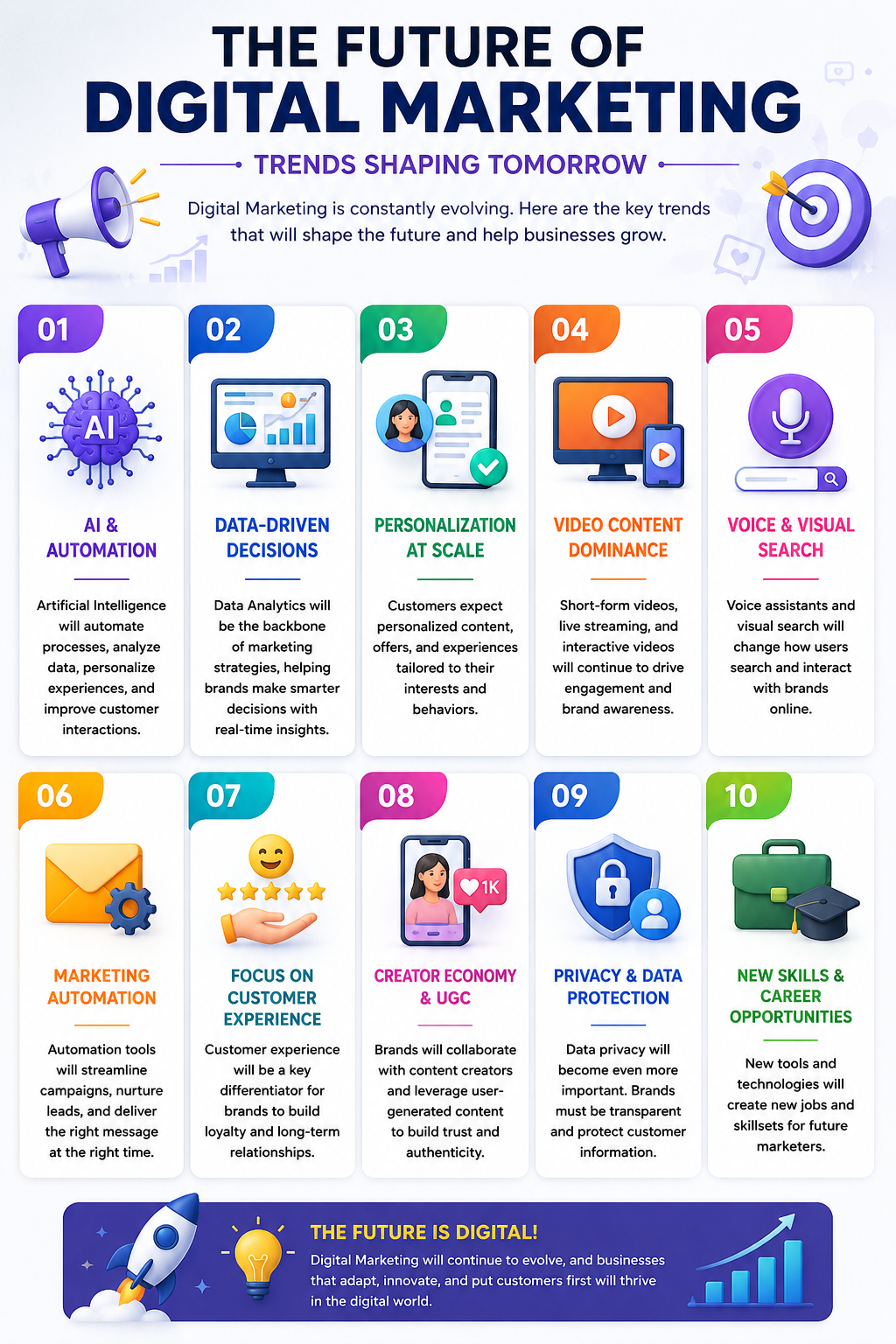
Latest Digital Marketing Trends
Digital Marketing continues to evolve rapidly as new technologies emerge and consumer behavior changes. Businesses and marketers must stay updated with the latest trends to improve customer experiences, optimize marketing campaigns, and maintain a competitive advantage in the digital marketplace.
1. Artificial Intelligence (AI) in Marketing
Artificial Intelligence (AI) has become a key driver of Digital Marketing by helping businesses:
- Create marketing content.
- Analyze customer data.
- Automate marketing campaigns.
- Improve customer support through AI chatbots.
- Deliver personalized product recommendations.
2. User-Generated Content (UGC)
Brands are increasingly relying on User-Generated Content (UGC), such as customer reviews, photos, videos, and testimonials. Authentic content created by users builds trust, increases engagement, and influences purchasing decisions.
3. Short-Form Video Content
Short videos have become one of the most popular content formats across platforms such as TikTok, Instagram Reels, and YouTube Shorts. They attract high engagement, improve brand visibility, and effectively capture audience attention.
4. Voice Search Optimization
With the growing use of voice assistants, optimizing content for Voice Search has become an important SEO strategy. Businesses are focusing on natural language and conversational keywords to improve search visibility.
5. Personalized Marketing
Businesses are using customer data to deliver personalized content, product recommendations, emails, and advertisements that match individual interests and behaviors, resulting in higher engagement and conversion rates.
6. Influencer Marketing
Influencer Marketing continues to grow, with many brands partnering with Micro-Influencers who have highly engaged audiences and strong credibility within specific niches.
7. Video Marketing
Video remains one of the most effective marketing formats. Educational videos, live streaming, product demonstrations, and customer testimonials help businesses increase engagement, build trust, and improve conversions.
8. Marketing Automation
Marketing Automation enables businesses to:
- Automate email campaigns.
- Manage customer journeys.
- Schedule social media content.
- Nurture leads.
- Improve marketing efficiency.
Automation saves time while delivering more personalized customer experiences.
9. User Experience (UX) Optimization
Businesses are investing in faster websites, mobile-friendly designs, simple navigation, and seamless user experiences because better UX directly improves customer satisfaction and conversion rates.
10. Data-Driven Marketing
Modern marketers rely on data analytics to make informed decisions, understand customer behavior, optimize campaigns, measure performance, and maximize marketing return on investment (ROI).
Common Digital Marketing Mistakes
Digital Marketing is one of the most effective ways to grow a business, increase brand awareness, and drive sales. However, common mistakes can reduce campaign performance, waste marketing budgets, and lower conversion rates. Understanding and avoiding these mistakes is essential for achieving long-term marketing success.
1. Not Setting Clear Goals
Launching marketing campaigns without defining clear and measurable objectives makes it difficult to evaluate performance or determine whether the campaign has been successful.
2. Ignoring the Target Audience
Failing to understand your audience's needs, interests, behaviors, and preferences can result in ineffective campaigns and low customer engagement.
3. Neglecting Search Engine Optimization (SEO)
Ignoring SEO best practices can reduce a website's visibility in search engine results, leading to lower organic traffic and fewer potential customers.
4. Relying on a Single Marketing Channel
Depending on only one platform, such as social media or paid advertising, increases business risk. A diversified Digital Marketing strategy provides better stability and broader audience reach.
5. Creating Low-Quality Content
Publishing content that lacks value, originality, or relevance can reduce audience engagement and negatively affect brand credibility and customer trust.
6. Ignoring Data and Analytics
Failing to monitor Key Performance Indicators (KPIs) and campaign analytics prevents businesses from identifying successful strategies and areas that need improvement.
7. Poor User Experience (UX)
A slow website, confusing navigation, or a website that is not mobile-friendly can discourage visitors and significantly reduce conversion rates.
8. Ignoring Mobile Marketing
Since most users browse the internet using smartphones, failing to optimize websites, advertisements, and content for mobile devices can result in lost opportunities and lower engagement.
9. Not Testing Marketing Campaigns
Launching campaigns without conducting A/B Testing can prevent businesses from identifying the most effective advertisements, landing pages, or marketing messages.
10. Focusing Only on Sales
Constantly promoting products without providing educational, informative, or entertaining content can reduce customer trust. Building relationships and delivering value should be part of every Digital Marketing strategy.
How to Start Learning Digital Marketing
If you want to build a career in Digital Marketing, it's important to follow a structured learning path that combines theoretical knowledge with hands-on practice. Digital Marketing is a broad field that includes multiple specialties, and continuous learning is essential to keep up with industry trends and technological advancements.
1. Learn the Fundamentals of Digital Marketing
Start by understanding the core concepts, including:
- What is Digital Marketing?
- Types of Digital Marketing.
- Digital Marketing channels.
- The Customer Journey.
- Marketing strategy fundamentals.
Building a strong foundation will make it easier to learn advanced marketing skills.
2. Learn Search Engine Optimization (SEO)
Study how to:
- Conduct keyword research.
- Optimize website pages.
- Create SEO-friendly content.
- Build high-quality backlinks.
- Improve website speed and user experience.
SEO is one of the most valuable skills for any digital marketer.
3. Learn Paid Advertising
Gain experience with advertising platforms such as:
- Google Ads.
- Meta Ads (Facebook & Instagram).
- TikTok Ads.
- LinkedIn Ads.
Learn how to create campaigns, target the right audience, manage advertising budgets, and analyze campaign performance.
4. Learn Content Marketing
Develop skills in creating:
- Blog articles.
- Marketing content.
- Social media posts.
- Landing pages.
- Copywriting.
High-quality content is the foundation of successful Digital Marketing campaigns.
5. Learn Social Media Marketing
Understand how to manage business accounts, create engaging content, schedule posts, interact with audiences, and analyze performance across platforms like Facebook, Instagram, TikTok, LinkedIn, and X.
6. Learn Digital Marketing Tools
Practice using industry-standard tools such as:
- Google Analytics.
- Google Search Console.
- Google Ads.
- Canva.
- ChatGPT.
- SEMrush.
- Ahrefs.
- Mailchimp.
Mastering these tools will improve your productivity and marketing effectiveness.
7. Practice What You Learn
Create your own website, blog, or social media pages and start applying your knowledge by running real marketing campaigns. Practical experience is one of the fastest ways to develop your skills.
8. Take Online Courses and Earn Certifications
Learn from trusted platforms that offer professional Digital Marketing training, including:
Professional certifications can strengthen your resume and demonstrate your expertise.
9. Stay Updated with Industry Trends
Follow marketing blogs, watch educational videos, attend webinars, and keep up with the latest developments in SEO, AI, paid advertising, content marketing, and marketing automation.
10. Build a Professional Portfolio
Showcase your work by including projects such as:
- SEO articles.
- Advertising campaigns.
- Marketing strategies.
- Social media content.
- Analytics reports.
- Website optimization projects.
A strong portfolio helps you attract employers or freelance clients.
Essential Digital Marketing Skills
Success in Digital Marketing requires a combination of technical, analytical, creative, and communication skills. As the digital landscape continues to evolve, marketers must continuously develop their expertise to create effective campaigns, reach the right audience, and achieve measurable business results.
1. Search Engine Optimization (SEO)
SEO is one of the most valuable skills for digital marketers. It includes:
- Keyword research.
- On-page SEO optimization.
- Content optimization.
- Link building.
- Improving website speed and user experience.
Strong SEO skills help increase organic traffic and improve search engine rankings.
2. Paid Advertising
Digital marketers should understand how to create and manage advertising campaigns on platforms such as:
- Google Ads.
- Meta Ads (Facebook & Instagram).
- TikTok Ads.
- LinkedIn Ads.
This includes audience targeting, budget management, campaign optimization, and performance analysis.
3. Content Marketing and Copywriting
Content creation is essential for attracting and engaging audiences. Digital marketers should be able to create:
- Blog articles.
- Landing pages.
- Marketing copy.
- Social media posts.
- Email campaigns.
Content should be valuable, persuasive, and optimized for search engines.
4. Social Media Marketing
This skill involves:
- Managing social media accounts.
- Creating engaging content.
- Scheduling posts.
- Building audience engagement.
- Monitoring and analyzing campaign performance.
Effective Social Media Marketing helps businesses strengthen their online presence.
5. Data Analytics
Digital marketers must know how to analyze marketing data and measure key metrics such as:
- Website traffic.
- Click-Through Rate (CTR).
- Conversion Rate.
- Return on Investment (ROI).
- Return on Ad Spend (ROAS).
Data analysis supports informed decision-making and campaign optimization.
6. Email Marketing
Successful Email Marketing requires the ability to:
- Create email campaigns.
- Segment audiences.
- Automate email workflows.
- Improve open and click-through rates.
- Measure campaign performance.
Email remains one of the highest-performing digital marketing channels.
7. Digital Marketing Tools
Professional marketers should be familiar with industry-standard tools such as:
- Google Analytics.
- Google Search Console.
- Google Ads.
- Canva.
- ChatGPT.
- SEMrush.
- Ahrefs.
- Mailchimp.
These tools improve productivity, reporting, and campaign performance.
8. Basic Design Skills
Although professional design experience is not always required, understanding basic graphic design principles helps marketers create attractive marketing materials using tools like Canva or Adobe Express.
9. Communication and Creativity
Successful digital marketers should possess strong soft skills, including:
- Creative thinking.
- Problem-solving.
- Communication skills.
- Teamwork.
- Customer relationship management.
These skills help marketers create compelling campaigns and collaborate effectively.
10. Continuous Learning and Adaptability
Digital Marketing changes rapidly, making continuous learning essential. Marketers should stay updated with:
- Google algorithm updates.
- Social media platform changes.
- Artificial Intelligence (AI) technologies.
- New marketing tools.
- Emerging Digital Marketing trends.
Adaptability is one of the most important qualities for long-term success.
Digital Marketing Career Opportunities
Digital Marketing is one of the fastest-growing industries, offering a wide range of career opportunities across different specialties. As businesses continue to invest in digital channels, the demand for skilled digital marketers continues to increase. Whether you enjoy analytics, creativity, content creation, or advertising, there is a career path suited to your interests and expertise.
1. Digital Marketing Specialist
A Digital Marketing Specialist plans, manages, and optimizes digital marketing campaigns across multiple channels. Their responsibilities include developing marketing strategies, increasing brand awareness, generating leads, and analyzing campaign performance.
2. SEO Specialist
An SEO Specialist focuses on improving a website's visibility in search engine results by:
- Conducting keyword research.
- Optimizing website pages.
- Creating SEO-friendly content.
- Building high-quality backlinks.
- Monitoring website performance.
3. PPC Specialist
A Pay-Per-Click (PPC) Specialist manages paid advertising campaigns on platforms such as:
- Google Ads.
- Meta Ads (Facebook & Instagram).
- TikTok Ads.
- LinkedIn Ads.
Their goal is to maximize campaign performance while reducing customer acquisition costs.
4. Content Writer
A Content Writer creates various types of content, including:
- Blog articles.
- Landing pages.
- Marketing copy.
- Product descriptions.
- Social media content.
Content Writers also optimize their work for search engines using SEO best practices.
5. Content Marketing Specialist
A Content Marketing Specialist develops content strategies, manages editorial calendars, creates valuable content, and measures performance to increase brand awareness, customer engagement, and lead generation.
6. Social Media Manager
A Social Media Manager is responsible for:
- Managing business social media accounts.
- Creating engaging content.
- Scheduling posts.
- Running social media campaigns.
- Monitoring audience engagement and performance.
7. Email Marketing Specialist
An Email Marketing Specialist creates email campaigns, manages subscriber lists, automates email workflows, improves open and click-through rates, and analyzes campaign results.
8. Marketing Data Analyst
A Marketing Data Analyst collects and analyzes marketing data to measure campaign performance, identify trends, and provide insights that help businesses make data-driven marketing decisions.
9. Affiliate Marketing Specialist
An Affiliate Marketing Specialist manages affiliate programs, builds relationships with affiliates and publishers, tracks affiliate performance, and helps increase online sales through partnership marketing.
10. Digital Marketing Manager
A Digital Marketing Manager oversees all digital marketing activities within an organization. Their responsibilities include developing marketing strategies, managing teams, coordinating campaigns, allocating budgets, and ensuring marketing objectives are achieved.
11. E-commerce Specialist
An E-commerce Specialist focuses on improving online store performance, increasing sales, enhancing customer experience, managing product listings, and optimizing e-commerce marketing campaigns.
12. UGC (User-Generated Content) Specialist
A UGC Specialist manages campaigns that leverage user-generated content. They collaborate with content creators and customers to produce authentic content that builds trust, improves engagement, and increases conversion rates.
Conclusion
Digital Marketing has become an essential part of modern business success, enabling companies and individuals to reach their target audience, increase brand awareness, generate qualified leads, and drive sales through a wide range of digital channels and strategies. As technologies such as Artificial Intelligence (AI), Data Analytics, and Marketing Automation continue to evolve, Digital Marketing will become even more innovative, personalized, and data-driven.
Achieving success in Digital Marketing requires more than simply using digital tools. It involves setting clear goals, understanding your target audience, creating high-quality content, analyzing performance, and continuously adapting to new trends and technologies. By investing in the right skills, strategies, and marketing tools, businesses and marketers can build a strong digital presence, improve customer engagement, maximize return on investment (ROI), and achieve sustainable long-term growth in an increasingly competitive digital landscape.