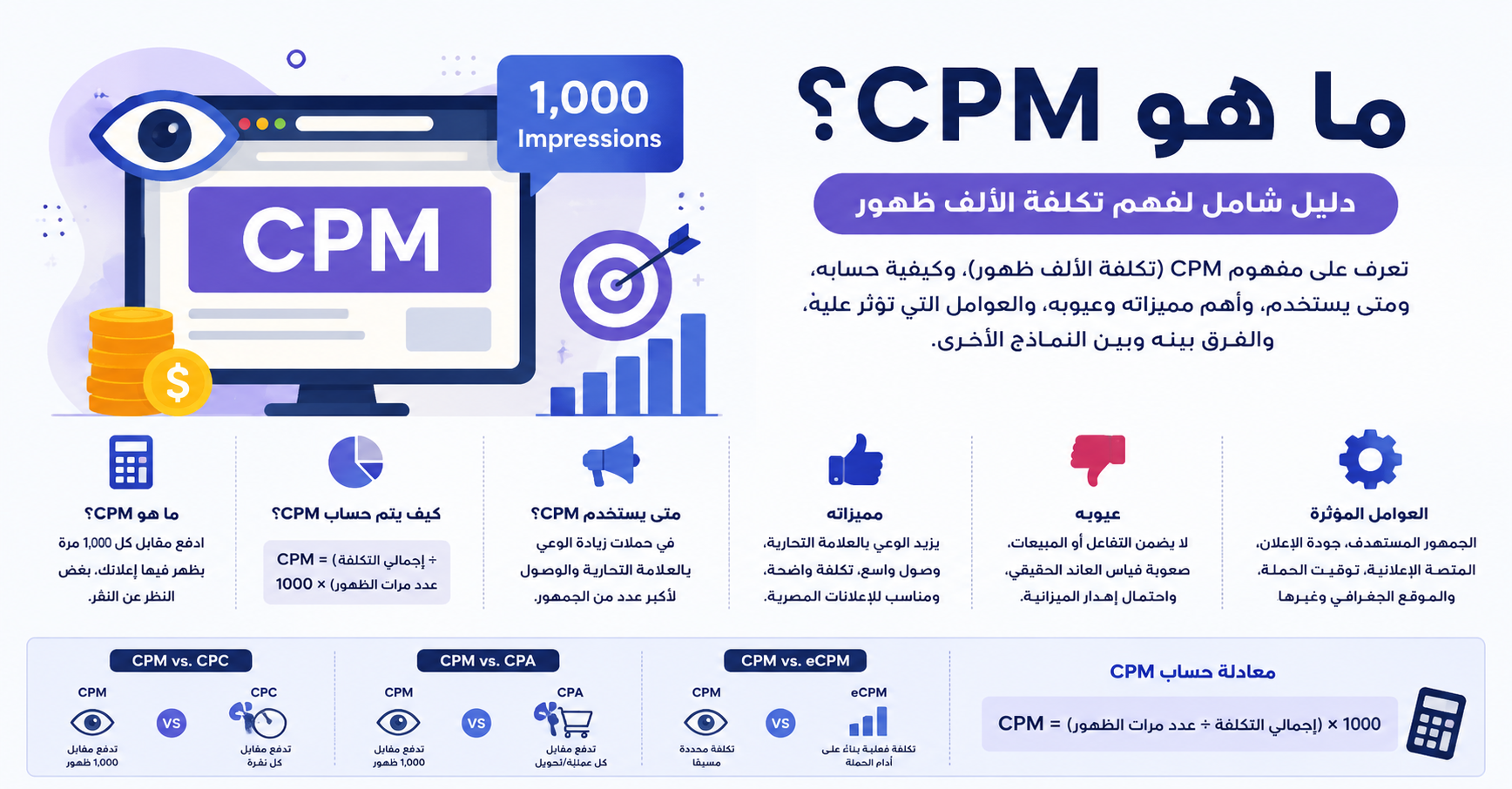
What Is CPM? A Complete Guide to Understanding Cost Per Mille and How to Calculate It
IntroductionWhen launching an advertising campaign, success is not only about creating an attractive advertisement or choosing the right audience. It also depends on selecting the advertising pricing model that aligns with your campaign objectives. Among the most commonly used pricing models in digital marketing is , which is considered the ideal choice for campaigns focused on increasing and reaching the largest possible audience
CPM (Cost Per Mille)brand awarenessBut what is ? How is it calculated? And when is it a better choice than other pricing models such as or ? In this comprehensive guide, you'll learn what is, how it works, its key advantages and disadvantages, the factors that influence its cost, and how to improve the performance of your advertising campaigns using CPM.
CPMCPCCPACost Per Mille ?What Is CPMstands for , which means . It is one of the most popular pricing models used in digital advertising. With this model, advertisers pay a fixed amount for every their advertisement is displayed to users, regardless of whether anyone clicks on the ad.
CPMCost Per MilleCost Per Thousand Impressions1,000 timesCPM is primarily used in advertising campaigns that aim to increase . The main objective is to reach as many people as possible and improve brand visibility, rather than generating clicks or direct sales.
Brand AwarenessTo better understand CPM, imagine you launch an advertising campaign on platforms such as or , and your ad is displayed . If your CPM is , you will pay for those impressions, even if no one clicks on the advertisement.
GoogleFacebook10,000 times$5$50 ? How Does CPM Workcalculates advertising costs based on the number of , not on clicks or conversions. This means advertisers pay a fixed amount for every their advertisement is displayed, regardless of whether users interact with it.
CPM (Cost Per Mille)Impressions1,000 timesWhen creating an advertising campaign and selecting the pricing model, the advertising platform delivers your ad to the target audience based on your campaign settings, such as , , and . Every time your advertisement reaches , one CPM charge is applied.
CPMlocationinterestsage group1,000 impressionsFor example, if your and your advertisement receives , the campaign cost will be:
CPM is $820,000 impressions(20,000 ÷ 1,000) × 8 = $160
Most digital advertising platforms, such as , , and , use the model for campaigns, although the cost per thousand impressions varies depending on the platform and the target audience.
Google AdsMeta AdsTikTok AdsCPMBrand AwarenessImportant Notes
- CPM is based solely on the number of .
- An advertisement can receive thousands of impressions without generating a single click.
- For this reason, CPM is commonly used for campaigns that focus on reaching as many users as possible rather than driving clicks or direct sales.
is calculated using a simple formula based on the total advertising cost and the number of .
FormulaCPM = (Total Campaign Cost ÷ Number of Impressions) × 1,000ExampleIf:
Campaign Cost = $160 Number of Impressions = 20,000The calculation would be:
(160 ÷ 20,000) × 1,000 = $8 CPM ? When Should You Use CPMThe pricing model is used when the primary goal of an advertising campaign is to increase the number of impressions and reach the largest possible audience, rather than generating clicks or direct sales.
CPM (Cost Per Mille)CPM is commonly used in the following situations:
- Launching a campaign.
- When you want your advertisement to be seen by as many people as possible.
- Promoting a new product or service.
- Advertising visual content such as videos or brand awareness campaigns.
- Running campaigns designed to maximize .
?When Is CPM Not Suitable
CPM may not be the best option if your primary goal is:
- Generating direct sales.
- Driving website traffic.
- Increasing conversions such as purchases, sign-ups, or downloads.
is one of the most popular pricing models in digital advertising and offers several advantages that make it suitable for specific campaign objectives.
CPM (Cost Per Mille)1. Increases Brand Awareness
CPM helps display your advertisement to a large audience, making it ideal for campaigns.
Brand Awareness2. Predictable Advertising Costs
Since the cost is charged per , advertisers can estimate and plan their advertising budget more effectively.
1,000 impressions3. Broad Audience Reach
It allows advertisers to reach a large number of users quickly, even if those users do not interact with the advertisement.
4. Ideal for Visual AdvertisementsCPM works particularly well for image and video advertisements, where the goal is to maximize visibility rather than encourage clicks
5. Supports Brand RecognitionRepeated exposure to the same audience helps improve brand recall and strengthens brand awareness over time.
6. Effective for Large Promotional CampaignsCPM is commonly used for product launches, company announcements, and large-scale promotional campaigns.
Disadvantages of CPM1. Does Not Guarantee Engagement
An advertisement may receive thousands of impressions without generating any clicks or meaningful user interaction.
2. Not Ideal for Direct SalesSince CPM focuses only on impressions, it does not guarantee sales or conversions.
3. Difficult to Measure Actual ROIIt can be challenging to evaluate campaign effectiveness when impressions are the primary performance metric.
4. Potential Budget WasteIf audience targeting is not accurate, your advertisement may be shown to users who are not interested in your product or service, resulting in wasted advertising spend.
5. Low-Quality Results in Some CasesA campaign may generate a large number of impressions without reaching a highly relevant audience or attracting genuine interest in the product.
Factors That Affect CPM
The cost of is influenced by several factors that determine whether it increases or decreases in advertising campaigns.
CPM (Cost Per Mille)
1. Target Audience
The more competitive your target audience is—such as high-income consumers or audiences in industries like finance and real estate—the higher your CPM is likely to be.
2. Ad Quality
Well-designed advertisements with compelling content generally achieve better performance, which can improve campaign efficiency and potentially reduce CPM.
3. Advertising Platform
CPM rates vary across advertising platforms such as and , depending on competition and audience demand.
Facebook, Instagram, Google,YouTube
4. Campaign Timing
During peak seasons and highly competitive periods, such as holidays or major shopping events, CPM tends to increase because more advertisers are competing for the same audience.
5. Country and Geographic Location
CPM varies from one country to another. Countries with higher purchasing power generally have higher advertising costs.
6. Targeting Quality
The more accurate and relevant your audience targeting is, the more efficient your campaign becomes, which may help lower CPM.
7. Ad Format
Different ad formats, such as , , , or , may have different CPM rates depending on the platform.
videomotionimagetext ads
How to Reduce CPM1. Improve Your Targeting
Target a specific and well-defined audience instead of a broad one, as random targeting increases competition and can drive up advertising costs.
2. Improve Ad Quality
Use attractive designs, compelling headlines, and clear messaging to increase audience engagement, improve ad performance, and potentially reduce CPM.
3. Increase Engagement
The more users interact with your advertisement through likes, comments, shares, or clicks, the better your ad performance may become, which can help lower CPM.
4. Run A/B Tests
Test multiple versions of your advertisement to determine which one delivers the best performance at the lowest cost.
5. Choose the Right Timing
Avoid launching campaigns during peak advertising seasons unless necessary, as higher competition usually leads to increased CPM.
6. Use a Custom Audience
Target users who have previously interacted with your brand, as they are often more cost-effective and more likely to engage with your advertisements.
7. Improve Ad Relevance
The more relevant your advertisement is to your target audience, the more efficiently advertising platforms can deliver it, which may reduce CPM and improve campaign performance.
? What Is a Good CPM
There is no fixed value that is considered a in every situation, because the cost depends on the advertising platform, country, target audience, and industry. However, a lower CPM combined with strong audience reach is generally considered a sign of a successful campaign.
good CPM (Cost Per Mille)
In most digital advertising campaigns, the average CPM typically ranges from . However, it may be higher in highly competitive industries such as and , or when targeting highly specific audiences.
$2 to $15finance, insurance,real estate
Estimated Average CPM by Industry
Industry
Average CPM
E-commerceLow to MediumEducationMediumSoftware & SaaSMedium to HighReal EstateHighFinance & Financial ServicesHighInsuranceVery High
? How Do You Know If Your CPM Is Good
- It is lower than the average CPM in your industry.
- It allows you to reach your target audience efficiently without exceeding your advertising budget.
- Your campaign is achieving its objective, such as increasing brand awareness or reaching the largest possible audience.
Do not rely on CPM alone to evaluate your campaign's success. Compare it with other metrics such as , , and to ensure that your advertisement is generating meaningful results rather than simply accumulating impressions.
Tip:ReachEngagement RateClick-Through Rate (CTR)
CPM vs. CPCand are two of the most commonly used pricing models in digital advertising. However, they differ in how advertisers are charged and the primary goal of each campaign.
CPM (Cost Per Mille)CPC (Cost Per Click)Pay per 1,000 ad impressionsPay per ad click Advertisers pay for every 1,000 impressionsAdvertisers pay when a user clicks on the ad Increase brand awareness and reachDrive website traffic and user engagement ImpressionsClicks Brand awareness campaigns and reaching the largest possible audienceTraffic, lead generation, and sales campaigns Higher impressions and reachMore clicks and a higher Click-Through Rate (CTR)
FeatureCPMCPCMeaningPayment MethodPrimary GoalWhat Is MeasuredBest Use CaseSuccess MetricIf you would like to learn more about , including how it is calculated and its key advantages and disadvantages, you can read our comprehensive guide on to explore all the details and choose the most suitable pricing model for your advertising campaigns.
CPC (Cost Per Click)CPC? Which One Is Better
There is no pricing model that is better in every situation. The right choice depends on your campaign objective.
- if your goal is to increase brand awareness and reach as many people as possible.
- if your goal is to drive more traffic to your website or generate more clicks and engagement.
and are popular pricing models in digital marketing, but they differ in how advertising costs are calculated and in the purpose of each campaign.
CPM (Cost Per Mille)CPA (Cost Per Acquisition/Action)Pay per 1,000 ad impressionsPay per acquisition or conversion Advertisers pay based on the number of impressionsAdvertisers pay when the desired action is completed, such as purchasing a product or registering an account Increase brand awareness and reachGenerate measurable results such as sales, registrations, or app installs ImpressionsConversions Brand awareness and reach campaignsPerformance marketing, sales, and lead generation campaigns Higher, since engagement or conversions are not guaranteedLower, because payment is made only after a successful conversion
FeatureCPMCPAMeaningPayment MethodPrimary GoalWhat Is MeasuredBest Use CaseRisk Level? Which One Is Better
The choice between and depends on the objective of your campaign.
CPMCPA- if your goal is to increase brand awareness and reach the largest possible audience.
- if your goal is to generate sales, registrations, or any other measurable conversion.
and are two commonly used advertising metrics, but they measure different things.
ReachImpressions- The number of unique people who have seen your advertisement at least once.
- The total number of times your advertisement is displayed, even if the same person sees it multiple times.
Example
If each see your advertisement , then:
100 people3 timesReach = 100Impressions = 300CPM vs. eCPM
Both and are important metrics in digital advertising, but each serves a different purpose.
Cost per 1,000 impressionsEffective cost per 1,000 impressions Determined in advance as a pricing modelCalculated based on the actual performance of the campaign Determines the advertising cost before launching the campaignMeasures campaign efficiency and compares different pricing models When choosing an impression-based pricing modelAfter the campaign has run to evaluate performance across CPM, CPC, or CPA campaigns
CPM (Cost Per Mille)eCPM (Effective Cost Per Mille)FeatureCPMeCPMMeaningCalculation MethodPurposeWhen Is It Used?
? How Is eCPM Calculated
The formula for calculating is:
eCPMeCPM = (Total Revenue or Campaign Cost ÷ Number of Impressions) × 1,000Example
If you spend on an advertising campaign and receive , then:
$10050,000 impressionseCPM = (100 ÷ 50,000) × 1,000 = $2
This means the .
effective cost per 1,000 impressions is $2Which One Is Better
Neither is better than the other because each serves a different purpose.
- is a pricing model used when creating an advertising campaign.
- is a performance metric used to evaluate campaign efficiency and compare results regardless of the pricing model used.
Conclusion
is one of the most important pricing models in digital marketing, especially for campaigns focused on increasing and reaching the largest possible audience. By understanding how CPM works, how it is calculated, and the factors that influence its cost, you can make more informed advertising decisions and maximize the value of your marketing budget.
CPM (Cost Per Mille)brand awarenessUltimately, choosing the right pricing model depends on your campaign objectives. If your goal is to increase brand awareness and expand your reach, is an excellent choice. However, if your objective is to drive more clicks or generate sales, pricing models such as or may be a better fit.
CPMCPCCPA